Table of Contents
- 1. QuTwo aims to prepare enterprises for quantum computing
- 2. Peter Sarlin’s Transition from AMD to New Ventures
- 3. Introduction to QuTwo and Its Mission
- 4. Funding and Support for QuTwo
- 5. Collaboration with Enterprise Customers
- 5.1 Partnership with Zalando
- 5.2 Joint Research Initiatives
- 6. Development of QuTwo OS for Quantum Transition
- 7. The Role of Mixed Hardware Environments
- 8. QuTwo’s Team and Expertise in Quantum and AI
- 9. The Future of Quantum Computing in Enterprises
- 9.1 Embracing Quantum Technologies
- 9.2 Navigating the Quantum Landscape
This article is based on reporting by TechCrunch (March 12, 2026) about Peter Sarlin and QuTwo.
QuTwo aims to prepare enterprises for quantum computing
- Peter Sarlin has left AMD Silo AI, 18 months after AMD acquired his startup Silo AI for $665 million.
- He is now chairman of two new ventures: physical AI lab NestAI and enterprise-focused QuTwo.
- QuTwo is building “QuTwo OS,” an orchestration layer to move AI workloads from classical to quantum—via hybrid approaches.
- Early enterprise work includes Zalando “lifestyle agents” and a joint quantum AI research initiative with OP Pohjola.
Four Layers of Quantum Readiness
Quantum readiness (as QuTwo frames it) tends to break into four practical layers:
1) Workload selection — identify AI workloads where efficiency, latency, or optimization complexity is already a bottleneck.
2) Algorithm options — map each workload to classical, quantum-inspired, and (where plausible) quantum approaches.
3) Execution model — plan for hybrid runs (classical + quantum/quantum-inspired components) rather than a full-stack replacement.
4) Orchestration & governance — put a routing layer in place so teams can express business intent while the platform decides where it runs.
Peter Sarlin’s Transition from AMD to New Ventures
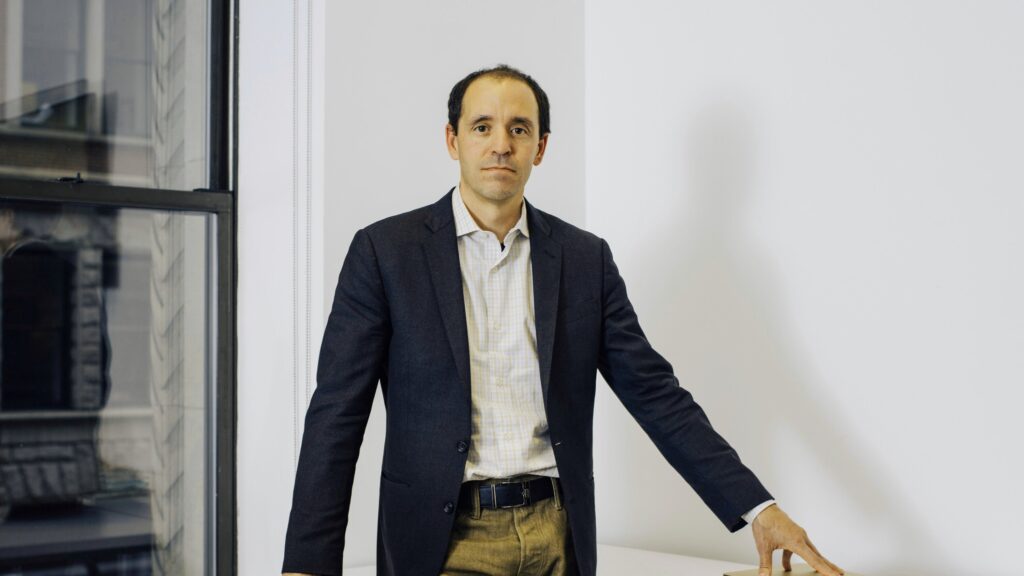
Eighteen months after chipmaker AMD acquired Silo AI for $665 million, Finnish entrepreneur Peter Sarlin has stepped away from his role as CEO of the unit now known as AMD Silo AI. The move marks a quick pivot from scaling an acquired AI business inside a semiconductor giant to building again—this time around a technology shift that is still more promise than product: quantum computing.
Sarlin’s next chapter is split across two chairs. One is NestAI, described as a physical AI lab. The other is QuTwo, a new enterprise startup positioning itself as an “AI lab for the quantum era.” The pairing is telling: Sarlin is not simply chasing the next model release cycle, but placing bets on the infrastructure and compute paradigms that could shape what AI can do—and how efficiently it can do it.
The timing also reflects a broader tension in AI: performance gains are increasingly expensive, and energy demands are becoming harder to ignore. Sarlin’s view, as he has framed it publicly, is that AI is approaching an efficiency wall—one that quantum computing may eventually help break through. But rather than wagering on a specific “quantum moment,” he is building a company designed to be useful before that moment arrives.
Sarlin’s Strategic Shift in AI
Why Sarlin’s move matters in this specific bet:
– Prior outcome: Sarlin sold Silo AI to AMD for $665 million, then ran the acquired unit (now AMD Silo AI).
– What he’s doing now: chairing NestAI (physical AI lab) and QuTwo (enterprise startup positioning itself as an “AI lab for the quantum era”).
– Throughline: taking an AI organization from startup scale into a major chipmaker, then returning to build an abstraction layer meant to survive shifting compute backends (classical → hybrid → quantum).
Introduction to QuTwo and Its Mission
QuTwo’s pitch is deliberately pragmatic: don’t wait for quantum computing to mature; start preparing enterprises to use it. The company describes itself as “an AI lab for the quantum era,” but it is explicit about what that means in practice. QuTwo is an AI company, Sarlin has said, focused on “pushing AI workloads from classical to quantum.”
That framing matters because it avoids a common trap in quantum narratives—treating quantum hardware as the product. QuTwo is instead building a layer that helps enterprises route workloads across different kinds of compute, including classical systems, quantum systems, and approaches in between. The goal is to let companies keep focusing on business problems while the platform handles the complexity of where and how computation runs.
In Sarlin’s telling, the mission is not to predict when quantum advantage will arrive, but to make the transition path real and operational. That includes “quantum-inspired” methods that run on classical hardware while simulating quantum behavior. In other words, QuTwo is trying to make “quantum readiness” something enterprises can buy and implement as a capability, not a research project.
Funding and Support for QuTwo
QuTwo is currently fully funded by Sarlin’s family office, PostScriptum. That structure gives the company a different starting posture than a typical venture-backed quantum startup: it can pursue long-horizon infrastructure work while still engaging commercially with enterprises early.
PostScriptum’s involvement also connects QuTwo to Sarlin’s broader set of quantum interests. Through the family office, Sarlin has invested in Finnish quantum companies IQM and QMill. Those investments signal conviction that quantum computing will eventually outperform classical computers across a wide range of industry applications—and could ease AI’s energy demands. But they also underline the uncertainty: the ecosystem is still developing, and early enterprise value often depends on hybrid approaches rather than pure quantum execution.
Funding and Strategic Backing
Funding & backing snapshot (as reported):
– Primary funding source: “currently fully funded” by Sarlin’s family office, PostScriptum.
– Related quantum exposure: PostScriptum investments in Finnish quantum companies IQM and QMill.
– Commercial signal (not a priced round): Sarlin says QuTwo already has “large design partnerships which are in the tens of millions.”
– Implication for product strategy: more freedom to build an orchestration layer that supports multiple algorithms and chips (quantum or non-quantum) rather than committing early to one hardware path.
Collaboration with Enterprise Customers
QuTwo is already working with enterprises, using design partnerships as both a product-development method and a market-entry strategy. In these arrangements, a vendor co-develops its product alongside customers—learning what enterprises expect while giving those customers early influence over the roadmap.
Sarlin has described QuTwo as commercially minded from the outset, and the company’s early customer work reflects that. Rather than selling a generic “quantum future” narrative, QuTwo is anchoring its efforts in concrete enterprise-facing AI tools and research initiatives. The bet from the customer side is straightforward: if quantum computing does arrive in a meaningful way, early movers want a foothold—technical, organizational, and strategic—before competitors catch up.
This approach also fits QuTwo’s core premise. Enterprises, in Sarlin’s view, would rather focus on their business problems while QuTwo OS handles routing across compute types. Design partnerships become the proving ground for that promise—where orchestration, hybrid execution, and “quantum-inspired” techniques can be tested against real workloads.
Design Partnership Development Loop
A typical design-partnership loop (what “co-developing” usually has to include for it to work):
1) Problem framing — agree on the business KPI (e.g., recommendation lift, latency, cost per inference) and the constraints (data access, privacy, uptime).
2) Workload decomposition — break the system into components that could be routed differently (retrieval, ranking, optimization, simulation, training/inference).
3) Baseline first — establish a classical baseline so “better” has a measurable meaning.
4) Prototype paths — test classical vs quantum-inspired (and later quantum) variants on the same evaluation harness.
5) Routing rules — define when QuTwo OS should choose each path (cost/latency/quality thresholds, fallback behavior).
6) Operational checkpoint — confirm monitoring, rollback, and incident ownership before anything touches production.
Common failure point to watch: skipping the baseline and ending up with a “quantum-ready” prototype that can’t be compared to what the business already runs.
Partnership with Zalando
One of QuTwo’s named enterprise collaborators is European fashion retailer Zalando. Together, they are developing what the companies call “lifestyle agents”—AI tools intended to go beyond product search and proactively suggest products and experiences.
The phrasing hints at a shift from reactive e-commerce interfaces to more proactive, agent-like systems. Instead of waiting for a user query, these agents aim to anticipate needs and propose options—an AI workload class that can be computationally demanding, especially as personalization and context expand.
For QuTwo, Zalando offers a high-volume, consumer-facing environment where AI performance and efficiency are not abstract concerns. If AI is indeed hitting an efficiency wall, retail personalization is one of the places it shows up quickly: richer recommendations typically mean more computation. The Zalando work also illustrates QuTwo’s near-term stance—building AI capabilities now, while designing them to be portable across future compute backends, including quantum.
Joint Research Initiatives
Beyond Zalando, QuTwo has launched a joint quantum AI research initiative with OP Pohjola, a major Finnish financial services provider. Financial services are often cited as a domain where advanced optimization and modeling can benefit from new compute approaches, and QuTwo’s collaboration places it in the middle of that experimentation.
The initiative also reinforces QuTwo’s dual identity: it is “building for the quantum world,” but it is doing so as an AI company. Research partnerships like this can serve two purposes at once. They help validate which AI workloads might realistically be pushed toward quantum or quantum-adjacent methods, and they help enterprises build internal understanding without committing to a single quantum hardware path.
In a landscape where quantum timelines remain uncertain, joint initiatives can be a rational compromise: enterprises get structured exploration tied to their domain problems, while QuTwo gets feedback that shapes its orchestration layer and algorithm support. The result is less about a single breakthrough and more about building the operational muscle memory that would be required if and when quantum capabilities become broadly useful.
Development of QuTwo OS for Quantum Transition
At the center of QuTwo’s product strategy is QuTwo OS, described as an orchestration layer designed to help companies shift from classical to quantum computing—using hybrid computing along the way. The emphasis on orchestration is a recognition that enterprises rarely replace compute stacks overnight. They add, integrate, and route.
Sarlin’s argument is that the first meaningful quantum deployments will not be “all-quantum.” They will be mixed environments where certain subproblems, algorithms, or workloads may benefit from quantum processors, while the rest remains classical. In that world, the hard part is not only writing quantum algorithms; it is deciding what runs where, and managing the transitions without forcing enterprises to become quantum infrastructure experts.
QuTwo OS is intended to be flexible: it is designed to support quantum or non-quantum algorithms and chips alike. That flexibility also creates room for “quantum-inspired” computing—approaches that simulate quantum behavior on classical hardware and are viable today because they work around hurdles that still hinder quantum hardware.
In effect, QuTwo OS is positioned as a bridge: useful immediately through quantum-inspired methods, and ready to route workloads to quantum hardware as it becomes practical.
Orchestrating Workload Execution Decisions
A simple way to think about what an “orchestration layer” must decide:
– Input: workload intent (objective + constraints), plus runtime signals (latency, cost, reliability, queue depth, model quality).
– Candidate paths:
– classical algorithm on classical hardware
– quantum-inspired algorithm on classical hardware
– quantum algorithm on quantum hardware (when available/appropriate)
– hybrid pipeline (split stages across backends)
– Decision rules (typical):
1) If the workload is production-critical, prefer the most reliable path with a defined fallback.
2) If the workload is optimization/search-heavy and bounded, test quantum-inspired first (viable today).
3) Route to quantum hardware only when the expected gain beats overhead (data movement, scheduling, error/noise constraints) and the evaluation harness shows a net win.
– Output: chosen backend + a logged rationale (so enterprises can audit “why did it run there?”).
The Role of Mixed Hardware Environments
Mixed hardware environments are not a temporary inconvenience in QuTwo’s worldview; they are the likely default for early enterprise quantum adoption. Sarlin has argued that initial use cases will require combinations of classical compute, quantum compute, and intermediate techniques—because quantum hardware still faces hurdles, and because enterprises need reliability and predictability.
This is where “quantum-inspired” computing becomes strategically important. It can deliver some of the conceptual benefits—new ways to structure optimization or search—without waiting for quantum machines to scale or stabilize. For enterprises, that means experimentation can start now, using familiar infrastructure, procurement paths, and operational controls.
QuTwo’s bet is that enterprises do not want to become experts in this complexity. They want to define business problems—recommendation quality, risk modeling, optimization constraints—and let a platform handle routing and execution choices. In that model, orchestration is not just a technical layer; it is a product boundary that separates enterprise intent from compute implementation.
By designing QuTwo OS to support quantum and non-quantum algorithms and chips, QuTwo is also hedging against a fragmented hardware future. If multiple quantum approaches compete, enterprises will value abstraction layers that reduce lock-in and keep options open.
| Approach | Runs on | What it’s good for (in enterprises) | Key trade-offs / constraints |
|---|---|---|---|
| Classical | Classical CPUs/GPUs | Most production AI today; predictable ops, mature tooling | May hit cost/energy/latency ceilings as workloads scale |
| Quantum-inspired | Classical CPUs/GPUs | Early experimentation with “quantum-like” optimization/search behavior without new hardware | Gains can be workload-specific; still bounded by classical hardware limits |
| Quantum | Quantum processors | Potential upside on specific problem classes as hardware/algorithms mature | Hardware constraints and operational overhead make it hard to treat as a drop-in replacement |
| Hybrid (classical + quantum/quantum-inspired) | Mixed | Practical transition path: keep reliable components classical while testing new backends for subproblems | Integration complexity; requires orchestration, evaluation harnesses, and clear fallbacks |
QuTwo’s Team and Expertise in Quantum and AI
QuTwo is staffed to operate on both sides of the quantum–AI divide. On the quantum side, the company includes IQM cofounder Kuan Yen Tan, and board member Antti Vasara, who is also chair at SemiQon, a Finnish semiconductor startup focused on quantum chips. On the enterprise and AI side, Sarlin is joined by Kaj-Mikael Björk, one of his former cofounders at Silo AI.
The board also includes Pekka Lundmark, the former CEO of Finnish telecom giant Nokia—an addition that signals enterprise-scale governance and operational experience, not just deep tech ambition.
Across both quantum and AI, QuTwo counts more than 30 quantum and AI scientists. That headcount suggests the company is building real technical capacity rather than simply packaging partnerships. But Sarlin has been clear about positioning. The practical implication is that QuTwo’s customer base could be broad—any enterprise with heavy AI workloads and an interest in future-proofing compute strategies.
In a market crowded with quantum hardware narratives, QuTwo is differentiating through an enterprise-facing, AI-first approach: build the software and orchestration needed to make quantum a deployable option, not a distant science project.
Leadership and Strategic Fit
Who’s who (as reported) and why it maps to QuTwo’s thesis:
– Peter Sarlin — Finnish entrepreneur; previously CEO of the unit now known as AMD Silo AI; now chair at QuTwo. Relevance: enterprise AI execution + compute strategy.
– Kaj-Mikael Björk — former Silo AI cofounder. Relevance: building enterprise AI products and teams.
– Kuan Yen Tan — IQM cofounder. Relevance: quantum hardware-side perspective.
– Antti Vasara — QuTwo board member; also chair at SemiQon (quantum-chip-focused semiconductor startup). Relevance: quantum semiconductor ecosystem and governance.
– Pekka Lundmark — former CEO of Nokia; QuTwo board. Relevance: enterprise-scale operations and board-level oversight.
Team scale note: QuTwo “counts more than 30 quantum and AI scientists,” indicating in-house technical capacity.
The Future of Quantum Computing in Enterprises
Enterprises are being asked to plan for quantum computing without a firm timeline for when it will deliver broad, repeatable advantage. QuTwo’s strategy—commercial design partnerships now, orchestration software that spans classical and quantum, and “quantum-inspired” methods that work today—reflects a middle path between hype and hesitation.
If quantum computing eventually outperforms classical systems across a wide range of industry applications, the winners in enterprise adoption may not be the companies that bought the first quantum machines. They may be the ones that built the operational capability to route the right workloads to the right compute at the right time—without breaking existing systems.
Practical Steps for Quantum Readiness
If you’re an enterprise leader evaluating “quantum readiness,” near-term actions that stay useful even if timelines slip:
– Inventory candidate workloads where cost/latency/energy is already painful (optimization, search, scheduling, large-scale personalization).
– Demand a baseline for every pilot (what the classical system achieves today, with the same data and KPIs).
– Start with hybrid by default (assume mixed environments; require a fallback path).
– Treat orchestration as a product requirement (routing rules, observability, and “why did it run there?” logs).
– Use design partnerships intentionally (tie co-development to measurable outcomes, not just exploration).
– Avoid single-hardware lock-in early (keep interfaces and evaluation harnesses portable across backends).
Freshness note: this reflects publicly available reporting as of March 2026; enterprise quantum capabilities and timelines can shift quickly.
Embracing Quantum Technologies
QuTwo’s message to enterprises is to treat quantum as a transition, not a switch. That means investing in tooling, abstractions, and partnerships that make experimentation possible now, while keeping architectures flexible enough to incorporate new chips and algorithms later.
The company’s early work—like Zalando’s “lifestyle agents” and the OP Pohjola research initiative—suggests that “quantum readiness” can be pursued through AI projects that already matter to the business, rather than isolated quantum pilots with unclear ownership.
Navigating the Quantum Landscape
The quantum landscape remains uncertain: different hardware approaches, evolving algorithms, and practical constraints that make hybrid environments likely. QuTwo is building for that uncertainty by focusing on orchestration and flexibility—supporting quantum or non-quantum algorithms and chips, and leaning on quantum-inspired computing as a viable bridge.
For enterprises, the takeaway is less about predicting the exact arrival date of quantum advantage and more about reducing future friction. If quantum becomes useful, the organizations that can integrate it fastest—because they already have routing, abstraction, and hybrid workflows in place—will be positioned to capture value first.
This perspective reflects weidemann.tech’s focus on enterprise execution: building and scaling complex, regulated, multi-stakeholder technology systems where orchestration layers, hybrid architectures, and operational readiness often matter as much as the underlying compute breakthroughs.
This article reflects publicly available information as of March 2026 and focuses on how QuTwo positions its product and partnerships for enterprise adoption. Quantum computing capabilities, vendor roadmaps, and practical timelines may shift as hardware and software mature, so some details may change with new disclosures. References to “quantum readiness” describe an operational approach to experimentation and hybrid deployment, not a prediction of when quantum advantage will occur.

I am Martín Weidemann, a digital transformation consultant and founder of Weidemann.tech. I help businesses adapt to the digital age by optimizing processes and implementing innovative technologies. My goal is to transform businesses to be more efficient and competitive in today’s market.
LinkedIn